PID Option B: Authenticated Channel with eID Card (B) with mDoc, ISO REST API
This document is archived and its content is outdated. It is kept for historical reference only.
this flow is currently not being actively maintained.
Basic Idea
Presentation of PID and QEAAs (EAAs) reusing the entire System for German eID or Smart-eID for PID. The protocol is based on ISO standards ISO 18013-5/-7 and ISO 23220 and has two options for QEAA handling:
- get PID and QEAA in one shot (request/response)
- get PID and QEAA independent of each other (multiple requests/responses)
Cryptographic Formats
Long-Term keys:
- PID Provider has long-term key pair that can be verified using
- RP has long-term key pair
Transaction-specific keys:
- RP contribution to HMAC key: RP generates ephemeral key pair
- PID Provider contribution to HMAC key: PID provider generates ephemeral device key pair for each request
Artifacts:
Sequence Diagram
User Journey: PID Presentation - Authenticated Channel - eID Card
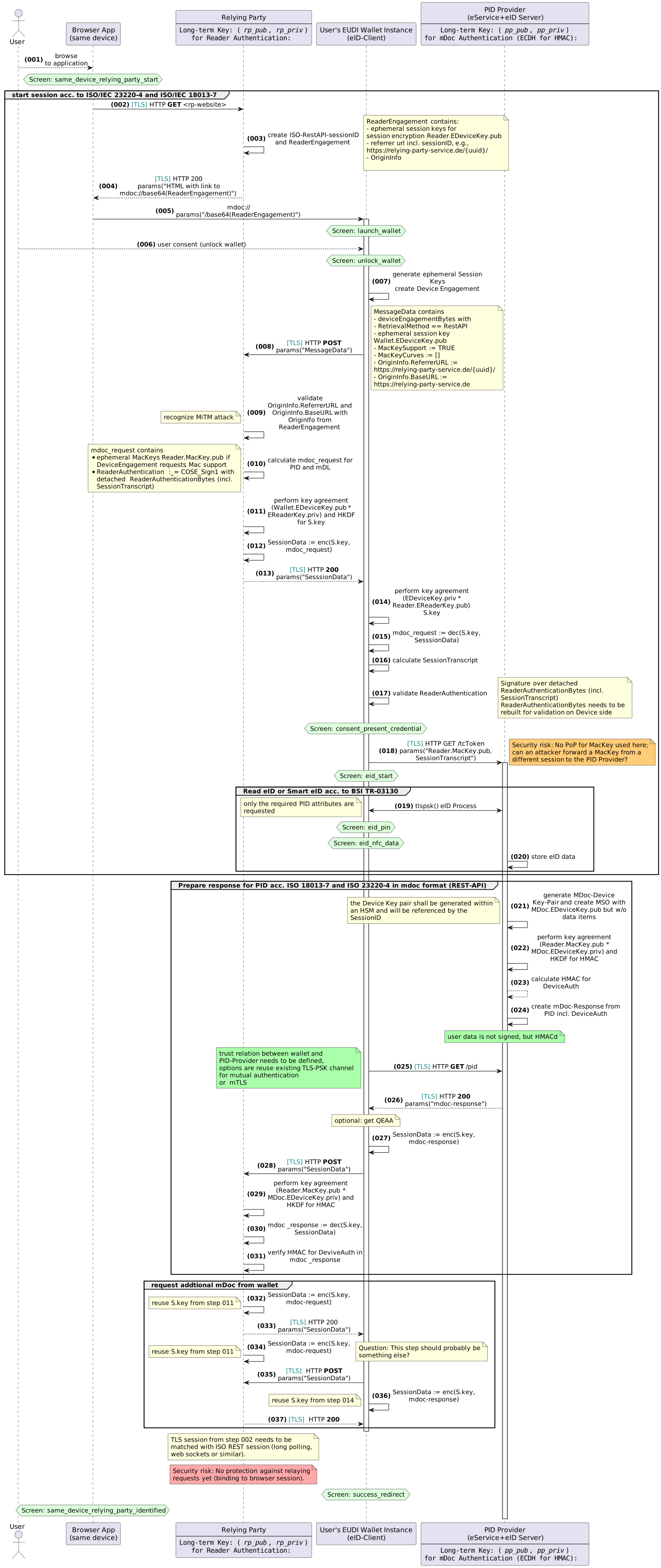
Step-by-Step Description
User browses to Relying Party (RP) website
- open the Browser app
- request RP website within the Browser app
- RP generates an ephemeral session key pair and a ReaderEngagement structure according to ISO 18013-7 annex A.1
- ReaderEngagement contains:
- the public ephemeral session key
- an OriginInfo structure with a referrer-url incl. a REST-API sessionID, e.g.,
https://rp.example.com/mdoc-reader/1234
- RP returns a HTML page to the browser containing a link to the wallet app (e.g.,
mdoc://enc(base64,ReaderEngagement))- The user clicks on the link and the wallet will be launched
- The wallet app retrieves the Authorization Request from the RP website (e.g.,
https://rp.example.com/mdoc-reader/1234) and the public ephemeral session key
- The user might be asked for consent to unlock the wallet (needs to be discussed!)
- RP generates an ephemeral session key pair and a DeviceEngagement structure according to ISO 18013-7 annex A.2
- DeviceEngagement indicates support of Mac keys for mDoc authentication
- DeviceEngagement contains an OriginIfo structure. This value shall not be determined using data from the ReaderEngagement structure.
- Wallet sends a CBOR encoded message data structure via HTTPS POST to the RP containing the DeviceEngagement structure
- RP validates OriginInfo from DeviceEngagement with provided ReaderEngagement from step 2
- RP calculates mDoc-request
- just for PID or PID and QEAA (e.g., mDL)
- mDoc-request contains items to request, public Reader Mac-key and ReaderAuthentication
- RP performs ECDH key agreement and calculates the symmetric session key S.key
- RP encrypts the mDoc-request with S.key
- RP returns the mDoc-request to the wallet
- wallet performs ECDH key agreement and calculates the symmetric session key S.key
- wallet decrypts mDoc-request with S.key
- wallet calculates SessionTranscript acc ISO 18013-7 A.8
- wallet performs Reader Authentication
- wallet starts eID-process if mdoc-request contains PID request
- wallet performs eID process acc. TR 03124
- PID-Provider stores eID data temporarily
- PID-Provider generates mDoc authentication key pair and creates an MSO structure, this might also be done for one time, e.g., during service startup
- optional: perform reading of additional QEAA's or EAA's by ruse of existing TLS-PSK channel
- PID-Provider performs ECDH and HKDF for HMAC key
- PID-Provider calculates HMAC for Device Authentication using the SessionTranscript
- PID-Provider calculates mDoc-response
- for PID and QEAA, if optional step 22. has been performed
- just for PID, if optional step 22. has been omitted
- wallet encrypts mDoc-response using session key S.key
- wallet posts the mDoc-response to the RP
- RP decrypts mDoc-response using S.key
- RP performs ECDH and HKDF for HMAC key
- RP verifies mDoc authentication
- optional: RP calculates an additional mDoc-request
- optional: RP returns additional mDoc-request to the wallet
- optional: Wallet encrypts mdoc-response
- wallet posts mdoc-response to RP
- RP ends the session
Implementation Considerations
TBD
Usability Considerations
The user expects a simple and intuitive user interface with the same or similar user experience as for other security-critical applications such as banking apps.
That means, that the entire session will be performed within the same instance of a browser window or tab. This applies in particular for the same-device flow as well as for the cross-device flow. For both flows, the user starts the session by requesting the website in step 002 and expects to get the result in the same browser window or tab.
Step 005 might be a deep link within a website behind a button for the same device flow or a qr-code with identical information mdoc://enc(base64,ReaderEngagement) for the cross-device flow.
At the end of the session the content of the browser window or tab from step 004 needs to be updated. To achieve this, at least 2 options are available:
- using long polling
- using websockets with notifications
The cross-device flow is mandatory for EUID wallet according to document "EUDIW Design Guide_Data Sharing Scenarios-v1.00_clean.doc".
- Unlock wallet (Step 006) should probably be moved to a later point in the flow, ideally just before using the credential.
Security Considerations
SessionTranscript: "Device Retrieval" with remote CA keys is defined by the ISO standards 18013-7 and 23220-4. The SessionTranscript is used within the authentication structure for the reader mDoc-request (ReaderAuthentication) and the authentication structure for the mDoc-response structure (DeviceAuthentication). The aim is the cryptographical binding of the data exchange protocol (request/response) with the underlying transport protocol REST-API. The SessionTranscript shall be created independently on each site of the communication channel.
- The SessionTranscript structure contains a ReaderEngagementHashBytes structure calculated using SHA256( ReaderEngagementBytes ) where ReaderEngagement contains the ephemeral RP public key (EReaderKeyBytes) and the URI of the RP website(TestApiOptions).
- The hashing of ReaderEngagementBytes prevents the leakage of session information from the Relying Party to the PID-Provider, for privacy reasons.
Cross-device Flow is mandatory for the EUID wallet. The proposed user flow as discussed in Usability Considerations (above) does not solve the problem of session hijacking by an attacker. Compared to the user experience to banking apps in combination with banking services, the RP does not know the wallet.
Proof of Possession (PoP) requires a kind of key attestation, which is not yet defined.
Privacy Considerations
- Selective Disclosure is achieved by ensuring that the credential contains only those data items (claims) that are requested by the RP. The list of requested claims is part of the request to the PID Provider.