Ecosystem Architecture
Person Identification Data (PID)
Runtime Views
Basic Idea
In this flow, long-lived, digitally signed PID credentials in ISO mdoc and IETF SD-JWT VC formats are issued to the Wallet Instance utilizing the OpenID4VCI protocol. During the issuance, the user is authenticated using the eID card, so when these PID credentials are presented to the Relying Parties over OpenID4VP protocol, there is no need for the user to use physical eID card. This flow trusts using Wallet Backend to manage keys on behalf of the Wallet Instance, under the assumption that keys managed on the mobile device cannot be secured in a way that is appropriate for Level of Assurance High (unlike Option C).
To improve user experience and prevent the users from tapping an eID card every time a batch of Credentials needs to be refreshed and tapping an eID card as many times as there are Credentials in a batch, a concept of Seed Credential is introduced. A Seed Credential is used to acquire a set of single-use Batch Credentials from the Provider. The Wallet can then present these Batch Credentials to the Relying Parties. The user only needs to present the physical ID card once - to acquire the Seed Credential - instead of every presentation.
Such Seed Credential is issued by a PID Provider to the Wallet as a signed DPoP-bound refresh token and can be stored for a longer period. The key from the wallet backend, that the refresh token is bound to, is stored and managed by an HSM in the wallet backend (WSCD) instead of the wallet device itself.
Wallet Attestation PoP and DPoP Proof are bound to the keys managed by a wallet backend, but since they contain session specific information (audience and a nonce/session id) that should be known only to the wallet instance from a privacy perspective, to generate a signature, the wallet instance sends only a ready-to-be-signed hash to the wallet backend. Wallet Attestation PoP and DPoP Proof require key attestation for the keys that they are bound to.
Cryptographic Keys
Prefixes
| Prefix | Meaning |
|---|---|
wb_ | Wallet Backend |
pp_ | PID Provider |
| Prefix | Meaning |
|---|---|
rp_ | Relying Party |
device_ | Wallet Instance |
Long-Term keys
| Key | Meaning |
|---|---|
| Wallet Instance generates locally managed key pair which is used to bind the PIN proof to the device. | |
Wallet Instance generates AES key which is used to derive the pin_derived_eph_priv used as PoP of Wallet PIN. | |
| Wallet Backend has key pairs with postfixes which are each used: - to sign wallet instance's wallet attestations: _wa- to sign key attestation for the key that a PID is bound to: _kbp- to sign key attestation for the key that a seed credential is bound to: _ks- to sign key attestation for the key that a DPoP Proof is bound to: _kd. | |
| Wallet Backend generates the key pair which is used to sign proof of possession of wallet attestation. | |
| Wallet Backend generates the HSM bound key pair which is used to generate DPoP proof (a key to which refresh token used as a seed credential is bound to). | |
| PID Provider has the HSM bound long-term key pair to sign over the issued Credential and to sign over the Refresh Token JWT. | |
| PID Provider has this symmetric long-term key which is used to encrypt eID data inside the refresh token. | |
| Relying Party has this long-term key pair which is used to sign over the authorization request, authenticating its contents. |
The following sequence diagrams include, among other things, user interactions with the Wallet. These interactions are not normative; only the depicted data flows are normative.
Issuance of a Refresh Token used as a Seed Credential
Sequence Diagram
-> Visual Example of the User Journey: PID Issuance - Issuer Signed - Cloud
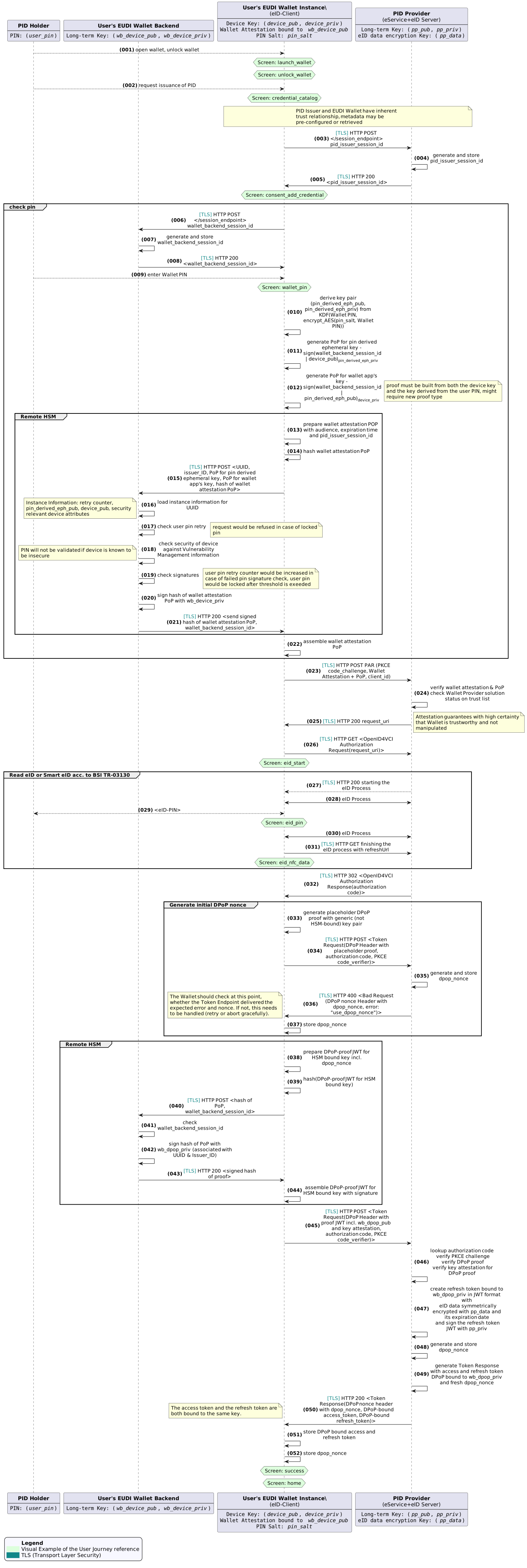
Step-by-Step Description
| No | Description |
|---|---|
| 001 | The user opens and unlocks the Wallet. |
| 002 | The user browses through the pre-configured credential catalogue and chooses to request a PID. |
| 003 | The Wallet requests a fresh pid_issuer_session_id from the PID Provider. |
| 004 | The PID Provider generates a fresh pid_issuer_session_id linked to the issuance session. |
| 005 | The PID Provider returns the pid_issuer_session_id to the Wallet. |
| 006 | The Wallet obtains fresh wallet_backend_session_id from the Wallet Backend's session endpoint. |
| 007 | Part of the above-mentioned module. |
| 008 | Part of the above-mentioned module. |
| 009 | The User enters the Wallet PIN. |
| 010 | The Wallet proves possession of the Wallet PIN {See "Wallet proving possession of the PIN" module for a detailed description of the steps). |
| 011 | Part of the above-mentioned module. |
| 012 | Part of the above-mentioned module. |
| 013 | The Wallet prepares a Wallet Attestation PoP containing audience, expiration time and pid_issuer_session_id |
| 014 | The Wallet hashes the prepared Wallet Attestation PoP. |
| 015 | The Wallet sends a request to the Wallet Backend containing UUID & Issuer_ID, PoP for pin_derived_eph_priv, PoP for device_priv and hash of the Wallet Attestation PoP |
| 016 | The Wallet Backend checks Wallet Instance. |
| 017 | Part of the above-mentioned module. |
| 018 | Part of the above-mentioned module. |
| 019 | The Wallet Backend validates the PoP for pin_derived_eph_pub and device_pub. |
| 020 | The Wallet Backend signs the hash of Wallet Attestation PoP with wb_device_priv. |
| 021 | The Wallet Backend returns the request to the Wallet containing signed hash of Wallet Attestation PoP. |
| 022 | The Wallet assembles the Wallet Attestation PoP using the signature received in a previous step. |
| 023 | The Wallet sends the Pushed Authorization Request to the PID Provider, containing the Wallet Provider's client_id, authorization_details for PID, a PKCE code_challenge and a wallet attestation and proof of possession. |
| 024 | The PID Provider verifies the wallet attestation and its proof of possession and validates the certification status of the Wallet Solution on a trust list. |
| 025 | The PID Provider returns a request_uri that is bound to the Pushed Authorization Request. |
| 026 | The Wallet sends the Authorization Request; containing the PAR request_uri. |
| 027 | The PID Provider responds with the first step to start the eID process with the Wallet, e.g. the tcToken, to authenticate the user. |
| 028 | Further communication is exchanged to perform the eID process. |
| 029 | The user provides the eID PIN to the Wallet. |
| 030 | Further communication is exchanged to perform the eID process. |
| 031 | The eID process is finished and as a final step the Wallet sends a request to the PID Provider calling the refreshURL. From now on Wallet and PID Provider are using the TLS-PSK channel generated by the eID flow. |
| 032 | The PID Provider responds to the Wallet with an Authorization Response containing the authorization code. |
| 033 | The Wallet generates (and stores) a placeholder DPoP proof with a generic (not HSM-bound) keypair to trigger an error response from the Token endpoint necessary to retrieve the dpop_nonce. |
| 034 | The Wallet sends a Token Request to the PID Provider; containing the placeholder DPoP proof. |
| 035 | The PID Provider generates and stores a dpop_nonce. |
| 036 | The PID Provider responds with the expected error "use_dpop_nonce" containing the dpop_nonce to be used from now in the DPoP nonce header. |
| 037 | The Wallet extracts and stores the dpop_nonce. |
| 038 | The Wallet now prepares the actual DPoP-proof JWT for the HSM-bound wb_dpop_pub including the dpop_nonce and iat. |
| 039 | The Wallet hashes the DPoP proof. |
| 040 | The Wallet sends a request to the Wallet Backend to sign the hash of the DPoP-proof for the HSM bound key containing the hash of the PoP for the HSM bound key and the wallet_backend_session_id. |
| 041 | The Wallet Backend validates the wallet_backend_session_id and loads session context. |
| 042 | The Wallet Backend signs the hash of the PoP for the HSM bound key with wb_dpop_priv (associated with UUID & Issuer_ID) from the HSM. |
| 043 | The Wallet Backend returns the signed hash of the PoP for the HSM bound key to the Wallet. |
| 044 | The Wallet assembles the DPoP-proof for the HSM bound key using the signature received in a previous step. |
| 045 | The Wallet sends a Token Request to the PID Provider containing a DPoP Header with the DPoP-proof JWT incl. wb_dpop_pub, the authorization code from Authorization Response, the PKCE code_verifier matching the code_challenge from Authorization Request and the.key attestation for wb_dpop_pub. |
| 046 | The PID Provider matches the code, verifies the PKCE code_verifier to the previously received code_challenge and verifies the DPoP proof. |
| 047 | The PID Provider then generates an access token and a refresh token bound to the DPoP key wb_dpop_priv in JWT format, signed with pp_priv containing the eID data encrypted with pp_data and the expiration date of the refresh token. |
| 048 | The PID Provider generates and stores a fresh dpop_nonce. |
| 049 | The PID Provider generates a Token Response containing the DPoP-bound access token (bound to wb_dpop_priv), the DPoP-bound refresh token (bound to wb_dpop_priv), a c_nonce and a fresh dpop_nonce in the DPoP nonce header. |
| 050 | The PID Provider sends the Token Response to the Wallet. |
| 051 | The Wallet stores the access and the refresh token. |
| 052 | The wallet stores the dpop_nonce. |
Issuance of a Batch of PIDs
Sequence Diagram
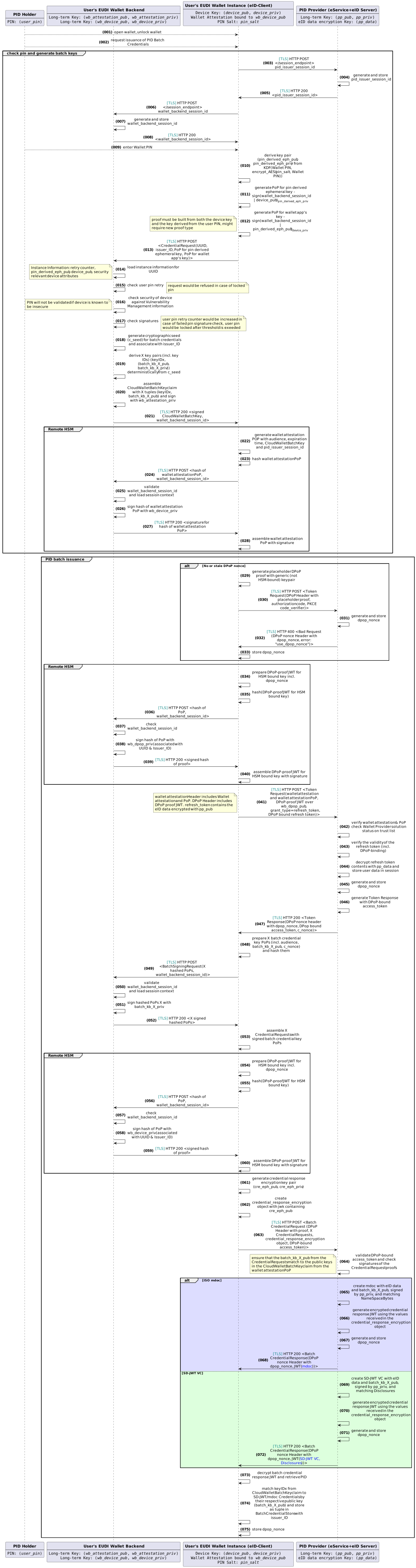
Step-by-Step Description
| No | Description |
|---|---|
| 001 | The user opens and unlocks the Wallet. |
| 002 | The Wallet requests issuance of PID Batch Credentials. |
| 003 | The Wallet requests fresh wallet_backend_session_id. |
| 004 | The Wallet Backend generates and links it to the session. |
| 005 | The Wallet Backend returns the wallet_backend_session_id to the Wallet. |
| 006 | The Wallet requests a fresh pid_issuer_session_id from the Wallet Backend |
| 007 | The Wallet Backend generates a fresh wallet_backend_session_id linked to the session. |
| 008 | The Wallet Backend returns the pid_issuer_session_id to the Wallet. |
| 009 | The user enters the Wallet PIN. |
| 010 | The Wallet proves possession of the Wallet PIN. See "Wallet proving possession of the PIN" module for a detailed description of the steps. |
| 011 | Part of the above-mentioned module. |
| 012 | Part of the above-mentioned module. |
| 013 | The Wallet sends a Credential Request to the Wallet Backend containing the UUID & the Issuer_ID, the PoP for pin_derived_eph_priv and the PoP for device_priv. |
| 014 | The Wallet Backend checks Wallet Instance. See Issuance of Wallet Instance Attestation (WIA)¶ for a detailed description of the steps. |
| 015 | Part of the above-mentioned module. |
| 016 | Part of the above-mentioned module. |
| 017 | The Wallet Backend validates the PoP for pin_derived_eph_pub and device_pub. |
| 018 | The Wallet Backend generates a cryptographic seed (c_seed) for the batch credential keys and associates it with Issuer_ID. Each batch of credentials uses it's own c_seed, previous c_seeds are discarded when a new batch of credentials for a specific Issuer are requested. |
| 019 | The Wallet Backend deterministically derives the required number of key pairs incl. key IDs from c_seed. A mechanism for key derivation will be defined later. |
| 020 | The Wallet Backend assembles a claim called CloudWalletBatchKey containing the public part of the just generated key pairs and the respective key IDs and signs the claim with wb_attestation_priv. |
| 021 | The Wallet Backend returns the request to the Wallet; containing the signed CloudWalletBatchKey. |
| 022 | The Wallet prepares a Wallet Attestation PoP containing the audience, the signed CloudWalletBatchKey claim and the pid_issuer_session_id. |
| 023 | The Wallet hashes the Wallet Attestation PoP. |
| 024 | The Wallet sends a signing request to the Wallet Backend containing the hash of the Wallet Attestation PoP and the wallet_backend_session_id. |
| 025 | The Wallet Backend validates the wallet_backend_session_id and loads the session context. |
| 026 | The Wallet Backend signs the hash of the Wallet Attestation PoP with the respective wb_device_priv. |
| 027 | The Wallet Backend returns the request to the Wallet incl. the signed hash of the Wallet Attestation PoP. |
| 028 | The Wallet assembles the Wallet Attestation PoP using the signature received in a previous step. |
| 029 | The Wallet generates (and stores) a placeholder DPoP proof with a generic (not HSM-bound) keypair to trigger an error response from the Token endpoint necessary to retrieve the dpop_nonce. |
| 030 | The Wallet sends a Token Request to the PID Provider; containing the placeholder DPoP proof. |
| 031 | The PID Provider generates and stores a dpop_nonce. |
| 032 | The PID Provider responds with the expected error "use_dpop_nonce" containing the dpop_nonce to be used from now in the DPoP nonce header. |
| 033 | The Wallet extracts and stores the dpop_nonce. |
| 034 | The Wallet prepares the DPoP-proof JWT for the HSM-bound wb_attestation_pub including the dpop_nonce and iat. |
| 035 | The Wallet hashes the DPoP proof. |
| 036 | The Wallet sends a request to the Wallet Backend to sign the hash of the DPoP-proof for the HSM bound key containing a hash of the PoP for the HSM bound key. |
| 037 | The Wallet Backend validates the wallet_backend_session_id and loads the session context. |
| 038 | The Wallet Backend signs the hash of the PoP for the HSM bound key with wb_device_priv (associated with UUID & Issuer_ID) from the HSM. |
| 039 | The Wallet Backend returns the signed hash of the PoP for the HSM bound key to the Wallet. |
| 040 | The Wallet assembles the DPoP-proof for the HSM bound key using the signature received in a previous step. |
| 041 | The Wallet sends a Token Request to the PID Provider containing the Wallet Attestation + PoP in the wallet attestation Header, the DPoP-proof JWT over wb_attestation_pub, the grant_type "refresh_token" and the DPoP-bound refresh token. |
| 042 | The PID Provider verifies the wallet attestation and its proof of possession and validates the certification status of the Wallet Solution on a trust list. |
| 043 | The PID Provider verifies the validity of the refresh token (incl. DPoP-binding). |
| 044 | The PID Provider decrypts the refresh token contents with //pp_data// and stores the users identity attributes in the session. |
| 045 | The PID Provider generates and stores a dpop_nonce. |
| 046 | The PID Provider generates a Token Response with a DPop bound access token. |
| 047 | The PID Provider returns a Token Response to the Wallet containing the DPoP bound access_token, the c_nonce and a fresh dpop_nonce in the DPoP nonce header. |
| 048 | The Wallet prepares the required number of PoP (incl. audience and respective public key) for the batch credential keys and hashes them. |
| 049 | The Wallet sends a BatchSigningRequest to the Wallet Backend containing the required number of hashed batch credential key PoPs and the wallet_backend_session_id. |
| 050 | The Wallet Backend validates the wallet_backend_session_id and loads the session context. |
| 051 | The Wallet Backend signs the hashed batch credential key PoPs with the respective batch_kb_X_priv. |
| 052 | The Wallet Backend returns the request to the Wallet incl. the signed hashes of the batch credential key PoPs. |
| 053 | The Wallet assembles the required amount of CredentialRequests containing the signed batch credential key PoPs. |
| 054 | The Wallet prepares the DPoP-proof JWT for the HSM-bound //dev// key including the dpop_nonce and iat. |
| 055 | The Wallet hashes the DPoP proof. |
| 056 | The Wallet sends a request to the Wallet Backend to sign the hash of the DPoP-proof for the HSM bound key containing a hash of the PoP for the HSM bound key and the wallet_backend_session_id. |
| 057 | The Wallet Backend validates the wallet_backend_session_id and loads the session context. |
| 058 | The Wallet Backend signs the hash of the PoP for the HSM bound key with wb_dpop_priv (associated with UUID & Issuer_ID) from the HSM. |
| 059 | The Wallet Backend returns the signed hash of the PoP for the HSM bound key to the Wallet. |
| 060 | The Wallet assembles the DPoP-proof for the HSM bound key using the signature received in a previous step. |
| 061 | The Wallet generates a new ephemeral keypair (cre_eph_pub, cre_eph_priv). |
| 062 | The Wallet creates the credential_response_encryption JSON object containing a jwk containing the cre_eph_pub, the JWE alg parameter and the JWE enc parameter. |
| 063 | The Wallet sends a BatchCredentialRequest to the PID Provider containing the DPoP proof JWT, the required amount of CredentialRequests, the credential_response_encryption object and the DPoP bound access_token. |
| 064 | The PID Provider validates the DPoP bound access_token and checks the signatures of the CredentialRequests. The PID Provider has to ensure that the batch_kb_X_pub from the CredentialRequests match to the public keys in the CloudWalletBatchKey claim from the Wallet Attestation PoP. |
| 065 | (mdoc) The PID Provider creates the mdoc containing the issuerAuth with the batch_kb_X_pub as deviceKey and hashes of the eID data, the eID data as NameSpaceBytes and the status management information. |
| 066 | (mdoc) The PID Provider creates an encrypted JWT (JWE) using the values received in the credential_response_encryption object and adds (among others) the PID credential to the payload. |
| 067 | The PID Provider generates and stores a fresh dpop_nonce. |
| 068 | (mdoc) The PID Provider sends the Credential Response JWT containing the required amount of PID credentials as mdoc. |
| 069 | (SD-JWT) The PID Provider creates SD-JWT VC containing the SD-JWT with the batch_kb_X_pub as confirmation claim and hashes of the eID data, the eID data as Disclosures and the status management information. |
| 070 | (SD-JWT) The PID Provider creates an encrypted JWT (JWE) using the values received in the credential_response_encryption object and adds (among others) the PID credential to the payload. |
| 071 | The PID Provider generates and stores a fresh dpop_nonce. |
| 072 | (SD-JWT) The PID Provider sends the Credential Response JWT containing the required amount of PID credentials as SD-JWT VC. |
| 073 | The Wallet decrypts the Credential Response JWT using the cre_eph_priv. |
| 074 | The Wallet matches the key IDs (from the CloudWalletBatchKey claim) to the public keys in the Credential Response by their respective public keys and stores them as tuple in a BatchCredentialStore with the issuer_ID. |
| 075 | The Wallet extracts and stores the dpop_nonce. |
Credential Presentation
Sequence Diagram
-> Visual Example of the User Journey: PID Presentation - Issuer Signed - Cloud
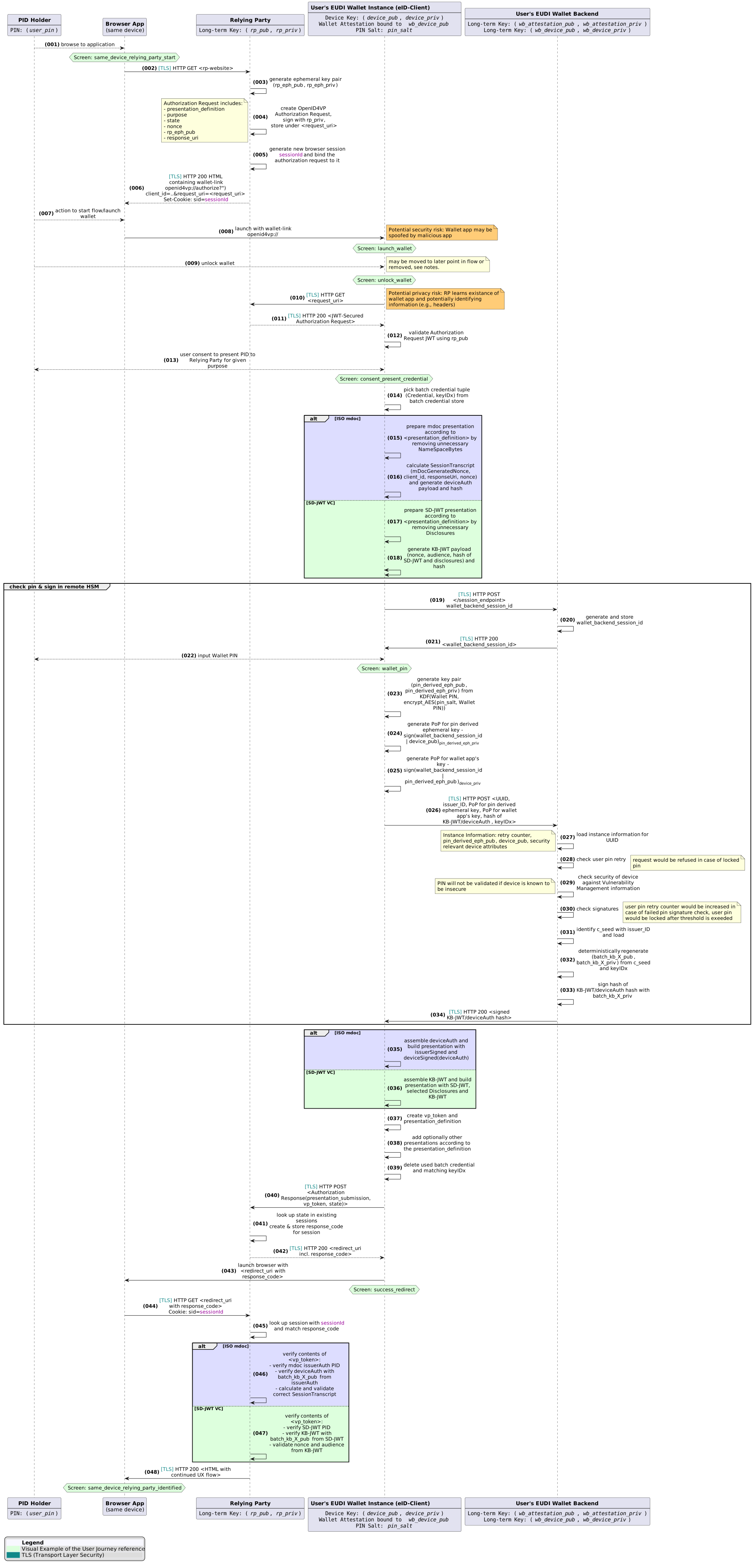
Step-by-Step Description
Note: While certain assumptions about session management of the Relaying Party are made here, the concrete implementation is considered out of scope for this document. The usual security considerations for web session management apply.
| No | Description |
|---|---|
| 001 | The user browses to Relying Party (RP) website. |
| 002 | Browser app on the user's device opens the RP website. |
| 003 | RP generates an ephemeral key pair (e.g., rp_eph_pub, rp_eph_priv). |
| 004 | RP generates an OpenID4VP Authorization Request and stores it under a request_uri (e.g., https://rp.example.com/oidc/request/1234). The request is bound to the user's browser session, it is signed using a key bound to the RP's metadata that can be retrieved using the RP's client_id. It contains the ephemeral key for response encryption. It contains RP's nonce and state. It contains the RP's response_uri endpoint for sending the Authorization Response over POST. |
| 005 | RP generates a new browser session and binds the generated Authorization Request to it. |
| 006 | RP returns a HTML page to the browser containing a link to the Wallet (e.g., openid4vp://authorize?client_id=..&request_uri=https://rp.example.com/oidc/request/1234) and a cookie with the browser sessionId is set. |
| 007 | The user clicks on the link. |
| 008 | The RP website navigates to the custom scheme link to launch the Wallet. |
| 009 | The user unlocks the Wallet (see notes below). |
| 010 | The Wallet sends a GET request to the RP's Authorization Request endpoint (e.g., https://rp.example.com/oidc/request/1234). |
| 011 | The Wallet retrieves the Authorization Request from the RP website. |
| 012 | The Wallet validates the Authorization Request using the RP's public key. Was the signature valid and the key bound to the RP's metadata? Security: This ensures that the Authorization Request was not tampered with; it does not ensure that the party that sent the Authorization Request is the RP. |
| 013 | The Wallet displays information about the identity of the Relying Party and the purpose, the user gives consent to present the PID. |
| 014 | The Wallet picks a batch credential tuple (Credential incl. possible disclosures, keyID) from the batch credential store. |
| 015 | (mdoc) The Wallet prepares an mdoc presentation according to the presentation_definition by removing NameSpaceBytes of not disclosed attributes. |
| 016 | (mdoc) The Wallet calculates the SessionTranscript according to ISO 18013-7 Annex B.4.4 from mDocGeneratedNonce, client_id, responseUri, nonce and generates the deviceAuthentication structure from SessionTranscript and NameSpaceBytes for signing and hashes the deviceAuthentication structure. |
| 017 | (SD-JWT) The Wallet generates an SD-JWT VC presentation according to the presentation_definition by removing Disclosures of not disclosed attributes. |
| 018 | (SD-JWT) The Wallet creates the header and payload for the KB-JWT from audience, nonce, hash of issuer-signed JWT and Disclosures for signing and hashes the payload. |
| 019 | The Wallet requests a fresh wallet_backend_session_id from the Wallet Backend. |
| 020 | The Wallet Backend generates a fresh wallet_backend_session_id linked to the session. |
| 021 | The Wallet Backend returns the wallet_backend_session_id to the Wallet. |
| 022 | The User enters the Wallet PIN. |
| 023 | The Wallet proves possession of the Wallet PIN. See "Wallet proving possession of the PIN" module for a detailed description of the steps. |
| 024 | The Wallet signs over the wallet_backend_session_id and the device-bound public key device_pub using the key pin_derived_eph_priv. |
| 025 | The Wallet signs over the wallet_backend_session_id and the Wallet PIN derived public key pin_derived_eph_pub using the key device_priv. |
| 026 | The Wallet sends a signing request to the Wallet Backend containing UUID & issuer_ID, PoP for pin_derived_eph_priv, PoP for device_priv, the hash of KB-JWT/deviceAuth and keyID (of the respective key that should be used to sign). |
| 027 | The Wallet Backend checks Wallet Instance. See Issuance of Wallet Instance Attestation (WIA) for a detailed description of the steps. |
| 028 | Part of the above-mentioned module. |
| 029 | Part of the above-mentioned module. |
| 030 | The Wallet Backend validates the PoP for pin_derived_eph_pub and device_pub. |
| 031 | The Wallet Backend loads the c_seed associated with the issuer_ID. |
| 032 | The Wallet Backend deterministically regenerates (batch_kb_X_pub, batch_kb_X_priv) from c_seed and keyIDx - A mechanism for key derivation will be defined later. |
| 033 | The Wallet Backend signs the hash of KB-JWT/deviceAuth with the respective batch_kb_X_priv. |
| 034 | The Wallet Backend returns the signed hashes of KB-JWT/deviceAuth to the Wallet. |
| 035 | (mdoc) The Wallet assembles the deviceAuth from header, payload and signature and builds the presentation from deviceAuth and issuerSigned. |
| 036 | (SD-JWT) The Wallet assembles the KB-JWT from header, payload and signature and builds the SD-JWT VC presentation from issuer-signed JWT, Disclosures and KB-JWT. |
| 037 | The Wallet creates a VP token and a presentation submission from the received credential. |
| 038 | Optional: The Wallet can add further presentations. |
| 039 | The Wallet deletes the used batch credential tuple (credential, keyID). |
| 040 | The Wallet sends the VP token and presentation submission to the RP (encrypted to the RP's public key rp_eph_pub). |
| 041 | The RP finds a session with the state and generates a response_code for this session. |
| 042 | The RP returns the redirect_uri with the response_code to the Wallet. |
| 043 | The Wallet launches the browser with the redirect_uri and response_code. |
| 044 | The browser sends the redirect_uri and response code to the RP, attaching the browser sessionId as a cookie. |
| 045 | The RP looks up whether there exists a session with the sessionId from the cookie and a matching response_code. |
| 046 | (mdoc) The RP verifies the PID in the VP token and verifies the SessionTranscript calculated from nonce, mDocGeneratedNonce, client_id, response_uri. |
| 047 | (SD-JWT) The RP verifies the SD-JWT PID in the VP token, verifies the KB-JWT using the batch_kb_X_pub in the SD-JWT, and verifies the nonce and audience in the KB-JWT. |
| 048 | The RP considers the user to be identified in the session context and continues the UX flow. |
Wallet proving possession of the PIN
Generation of a Proof of Knowledge of the Wallet PIN
A PIN-derived ephemeral public key that is needed to validate the signature on
this JWT must be included in the jwk header parameter. There must be a JWT
header parameter typ with the value being pin_derived_eph_pub_pop. The JWT
payload must contain an aud claim whose value is equal to the Wallet backend's
Identifier. wallet_backend_session_id must be included in a
wallet_backend_session_id parameter.
Below is a non-normative example of a JWT generated as a PoP for pin derived ephemeral key:
{
  "alg": "...",
  "typ": "pin_derived_eph_key_pop",
  "jwk": {
    "kty": "EC",
    "crv": "P-256",
    "x": "bPP7f...gW_ao",
    "y": "38_Lg...VUCfW"
  }
}.
{
  "wallet_backend_session_id": "123456",
  "aud": "https://pid-issuer.example.com",
  "device_key": {
    "jwk": {
      "kty": "EC",
      "crv": "P-256",
      "x": "...",
      "y": "..."
    }
  }
}.[signature by the pin derived ephemeral pub key]
The jwk claim contains the public key of a PIN-derived ephemeral key pair.